Introduction: Breast cancer (BC) is the second leading cause of death in Mexican women. Comorbidity with type 2 Diabetes Mellitus (T2DM) is a risk factor for complications.
Objective: To evaluate the evolution of family functionality and coping in patients with BC and T2DM after 4 years of diagnosis.
Method: Longitudinal cohort study in women with BC and T2DM in Quintana Roo. Admission at the time of confirmed diagnosis of BC, discharge at 6 years of evolution. We studied: family function, coping, clinical, family and metabolic control variables.
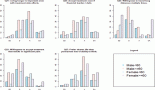
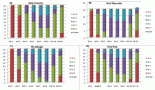
Results: 65 women, of whom 18 concluded the study. Family functionality (FF-SIL) 51.1 versus 44.72. Coping level: Problem solving 4.66% (0,10.8) versus 6.2% (5.6,44.4); Self-criticism 24.6% (14.9,33.8) versus 4.6% (0,34.9); Emotional expression 21.5% (11,32.3) versus 4.6% (0,38.9); Desiderative thinking 26.2% (14.9,37. 4) versus 1.5% (0.18.3); Social support 4.6% (0.11) versus 1.5% (0.18.3); Cognitive restructuring 3.1% (0.9.7) versus 4.6% (0.38. 9); Problem avoidance 6.2% (1.5,13.8) versus 3.1% (0,27.8); Social withdrawal 9.2% (1.5,20.4) versus 1.5% (0,22.2) p = >0.5.
Conclusion: The level of coping worsens over 4 years of evolution. Patients maintain their autonomy in decision making within the family. At diagnosis, families adapt; however, with the evolution, they infer sequelae of family health.