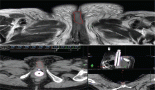
Objective: The aim of the present study is to evaluate the accuracy of Positron Emission Tomography/Computed Tomography (PET/CT) with Fluorodeoxyglucose ([18F]FDG) to predict treatment response in patients with locally advanced rectal cancer (LARC) during neoadjuvant chemoradiotherapy.
Patients and methods: Forty-one LARC patients performed [18F]FDG-PET/CT at baseline (PET0). All patients received continuous capecitabine concomitant to radiotherapy on the pelvis, followed by intermittent capecitabine until two weeks before curative surgery. [18F]FDG-PET/CT was also carried out at 40 Gy-time (PET1) and at the end of neoadjuvant therapy (PET2). PET imaging was analysed semi-quantitatively through the measurement of maximal standardised uptake value (SUVmax) and the tumour volume (TV). Histology was expressed through pTNM and Dworak tumor regression grading. Patients were categorised into responder (downstaging or downsizing) and non-responder (stable or progressive disease by comparison pretreatment parameters with clinical/pathological characteristics posttreatment/after surgery). Logistic regression was used to evaluate SUVmax and TV absolute and percent reduction as predictors of response rate using gender, age, and CEA as covariates. Progression-free survival (PFS) and overall survival (OS) were estimated by the Kaplan-Meier method. Survivals were compared by the Log-Rank test.
Results: Twenty-three responders (9 ypCR, 14 with downstaged disease) and 18 non-responders showed differences in terms of both early and posttreatment SUVmax percent reduction (median comparison: responder = 63.2%, non-responder = 44.2%, p = 0.04 and responder = 76.9%, non-responder = 61.6%, p = 0.06 respectively). The best predictive cut-offs of treatment response for early and posttreatment SUVmax percent reduction were ≥57% and ≥66% from baseline (p = 0.02 and p = 0.01 respectively).
Conclusions: [18F]FDG-PET/CT is a reliable technique for evaluating therapy response during neoadjuvant treatment in LARC, through a categorical classification of the SUV max reduction during treatment.