Introduction: Radiation therapy (RT) is crucial in the management of cervical cancer, particularly in resource-limited settings where most patients present with advanced-stage disease. Advances in external beam radiotherapy (EBRT) planning and delivery techniques, brachytherapy (BT) and systemic therapy necessitate context-adapted guidelines to standardise care. We developed a clinical practice guideline to improve and to harmonise the multidisciplinary management of cervical cancer in Uganda.
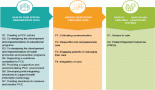
Methods: A multidisciplinary team of Radiation Oncologists, Medical Physicists and Radiation therapists developed the guideline using a modified Delphi process. The guideline was externally reviewed by experts from the International Gynaecological Radiation Oncology Consortium.
Results: All newly diagnosed patients should undergo multisciplinary evaluation prior to radiotherapy. For early-stage cervical cancer, adjuvant radiotherapy after hysterectomy is indicated in women with intermediate-risk factors, while concurrent cisplatin-based chemoradiation is indicated in women with high-risk factors. The standard EBRT dose is 45–50 Gy; women with vaginal and/or parametrial disease should receive adjuvant vaginal vault BT to achieve an equivalent dose in 2 Gy (EQD2) of 60 Gy. For locally advanced cervical cancer, the standard of care is pelvic EBRT (45–50 Gy in 25 fractions) with concurrent cisplatin (40 mg/m2 weekly for 5–6 cycles) followed by image-guided adaptive brachytherapy delivering 24–28 Gy in 3–4 fractions to achieve an EQD2 of 80–85 Gy for small tumours and 85–90 Gy for large tumours. The overall treatment time should not exceed 56 days. In recurrent disease, management depends on the location of the recurrence and the interval since the previous RT. In metastatic disease, palliative RT is directed to symptomatic sites.
Conclusion: This clinical practice guideline offers evidence-informed, context-specific recommendations for the use of EBRT and BT in cervical cancer management in Uganda. It aims to harmonise the role of RT within multidisciplinary care pathways.