Background: Colorectal adenocarcinoma (CRC) remains a leading cause of cancer-related mortality worldwide, with variable patient outcomes despite treatment advances. Traditional prognostic methods based on clinicopathological variables alone do not fully capture the biological complexity of the disease. This study aims to develop a risk scoring system based on genes associated with tumour-infiltrating immune cells (TIIC-associated genes) to improve prognostic assessment in CRC.
Methods: RNA-seq gene expression and clinicopathological data from The Cancer Genome Atlas Colorectal Adenocarcinoma (TCGA-CRC) database (647 tumour samples, 51 normal tissues) were analysed to identify differentially expressed TIIC-associated genes through comparison with the CIBERSORTx database. Univariate and multivariate Cox analyses were performed to screen for prognostic markers. A Gaussian mixture model was applied to cluster prognostic models and select the model with the most robust gene combination. The resulting risk scoring system was validated in an external cohort (GSE39582) and integrated with clinicopathological variables to develop a prognostic nomogram.
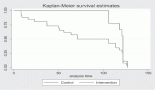
Results: From 128 TIIC-associated genes, an optimal prognostic model comprising CCL8 and Tyrosinase (TYR) was identified. The risk score was calculated as 0.152 × Exp(CCL8)–0.516 × Exp(TYR). Kaplan-Meier analysis confirmed significant survival differences between high-risk and low-risk groups in both TCGA-CRC and GSE39582 (p < 0.05). Time-dependent receiver operating characteristic analysis showed area under the curve (AUC) values ranging from 0.605 to 0.696 for 1-, 3- and 5-year survival in TCGA-CRC and GSE39582. Multivariate Cox analysis identified tumour (T stage), node (N stage) and risk score as independent prognostic factors.
Conclusion: Our risk scoring system based on CCL8 and TYR effectively stratifies CRC patients into distinct prognostic groups and could guide treatment decisions, particularly when integrated with TNM staging in a nomogram.