Introduction: Breast cancer is the most common malignancy in women worldwide, with significant geographic variation in incidence. Adjuvant radiotherapy (RT) improves outcomes but can cause underrecognised toxicities such as radiation-induced nausea, vomiting (RINV) and esophagitis. This study aims to correlate RINV and esophagitis with organ-at-risk (OAR) dose constraints and clinical factors.
Materials and method: This prospective observational study analysed upper gastrointestinal (GI) toxicity in breast cancer patients receiving adjuvant RT. Patient demographics, clinical characteristics and dose-volume parameters for the stomach and esophagus were recorded. Statistical analyses identified predictors of RINV and esophagitis using univariate and multivariate models. Significant correlations were reported with a p-value <0.05.
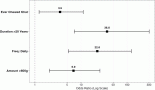
Results: The study included 110 female breast cancer patients (mean age 51 years), with volumetric modulated arc therapy (VMAT) as the predominant radiation technique and moderate hypofractionation (42.56 Gy/16 fractions) as the most prescribed regimen. Acute upper GI toxicity was observed in 60.9% of patients, with 3.6% experiencing Grade 3 toxicity. Higher stomach dose exposure (D10, D30 and D60cc) significantly correlated with increased toxicity (p < 0.001). Free breathing was associated with a higher risk of GI toxicity compared to deep inspiration breath-hold (DIBH) (p = 0.035), which showed a protective effect. Dysphagia was reported in 70% of patients, with esophageal mean dose strongly predicting severity (p < 0.001). Multivariate analysis confirmed stomach D30 cc and esophageal mean dose as independent predictors of high-grade toxicity. VMAT was associated with slightly higher toxicity compared to three-dimensional conformal RT.
Conclusion: Radiation technique, dose-volume parameters and breathing strategy significantly influence acute upper GI toxicity and dysphagia in breast cancer RT. DIBH reduces GI toxicity risk, while higher stomach and esophageal doses correlate with increased toxicity. Incorporating the stomach as an OAR and optimising treatment planning can enhance tolerability and improve patient outcomes.