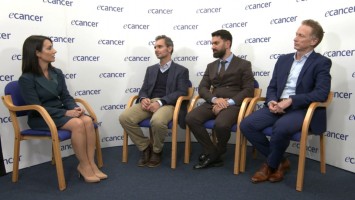
JP: Hello, welcome and thank you for joining us in this expert panel discussion as a part of the ecancer educational programme titled the latest in metastatic renal cell carcinoma. I’m Javier Puente, I’m a medical oncologist from Hospital Clinico in Madrid in Spain and it is my privilege to welcome you to this roundtable discussion meeting here in Berlin during this ESMO 2025 where important therapeutic advances have been taking place in the field of genitourinary cancer. For this discussion I have the privilege to share the stage with three outstanding colleagues, three experts in the field of kidney cancer, so let me introduce all of them before the discussion. First, Dr Viktor Grünwald from Essen Hospital in Germany, thank you for coming.
VG: Thank you.
JP: Dr Laurence Albiges from Gustave Roussy Hospital in Paris, France. Thank you.
LA: Thank you.
JP: And Dr Jens Bedke from Stuttgart Hospital here in Germany. Thank you for joining us.
JB: Thank you.
JP: So the aim of this discussion is to try to review the most recent data that has been presented during this ESMO 2025 in the field of kidney cancer. The most important is how can we affect it to our daily clinical practice. So I think that we need to move to the first line setting. Viktor, we have the recent data, the updated analysis of the CLEAR study with lenvatinib + pembrolizumab. This is the last review of the data with some of these phase III studies that we have compared the last years. What is the update of this study?
VG: Yes, we have different options in first line and all of these trials reported on different subgroups of patients. Bone metastatic patients do worse on any of those treatments so the question is really how did lenvatinib + pembrolizumab perform in patients that had bone metastatic disease. I think something we learned from the CLEAR study is that, first of all, bone metastatic disease is also a poor prognostic factor here in the CLEAR study which is reassuring and confirming the data we have seen before. But still lenvatinib + pembrolizumab outperforms sunitinib in terms of efficacy, in terms of survival, so it has all the assets that you need in order to render it an effective treatment for patients with bone metastatic disease. It’s [??] with the other subgroup analyses that we have seen previously, so more intense therapy for patients that are higher risk and that means bone metastatic disease makes a difference.
JP: Do you think if you have patients with bone mets you’re thinking in a combination of TKI plus IO or it doesn’t matter whatever you use in the first line?
VG: Yes, for me it’s a question. You do have a higher response also with ipilimumab + nivolumab but I think the TKI/IO combination is the safer bet because you have more patients failing ipilimumab + nivolumab. So it depends really also on the extent of bone metastatic disease and so on. I think these are numbers that really… I’ve used ipilimumab + nivolumab in patients with bone metastatic disease, that’s something I did. It also works but you’re just more on the safe side if you use a TKI/IO combination. I don’t think so, I think the third generation drugs – cabozantinib + nivolumab, lenvatinib + pembrolizumab, they’re very efficient in terms to control the tumour and the bone disease.
JB: The data is one piece in the puzzle and we have the puzzle of the TKI/IO combinations, of the ipilimumab + nivolumab, of the IO/IO combination, and we have data for the bone mets on the other combination and the piece of the puzzle for lenvatinib + pembrolizumab was missing. So this is one of the importance of this abstract of the presentation that they’ve now got this information that it’s really active in the bone metastatic disease too.
LA: Along these lines I think Jens is right, those patients are symptomatic on the bone mets so you want to achieve a high response rate, you want to avoid further disease progression and this is what is being driven with the IO/TKI strategy.
JP: And we have another abstract presented by Cristina Suárez, the KEYMAKER-U03A study with different combinations and one of them is the control with lenvatinib + pembrolizumab. Have you seen the data, Laurence, can you share your thoughts on that?
LA: Yes, absolutely. So bearing inn mind this is a phase I/II, it’s actually a very large study and the study was conducted both in first line and second line testing a new treatment strategy with multiple drugs. So here we only had the update of the frontline setting, so no prior exposure to systemic therapy, and in this multi-arm you had… I’m not going to say a comparator arm, although it’s not being built to have a head-to-head comparison, that was lenvatinib + pembrolizumab as we just heard in the recent update of the CLEAR data. The other arms were building on – adding a CTLA-4, adding a HIF inhibitor, belzutifan, and so on, different targets were tested like TIGIT and so on. So what is very interesting in this update is the data of the arms that are now explored in the phase III, challenging two drugs versus three drugs. I’m going to focus on two arms: one which is lenvatinib plus pembrolizumab plus belzutifan and one that is lenvatinib, pembrolizumab plus quavonlimab, the CTLA-4. What we are seeing is high response rates and long PFS so therefore it is building the confidence that potentially we can do even better than lenvatinib + pembrolizumab. So we need, of course, to have the confirmation in the phase III, that is the 012 study that is fully enrolled and still pending the results. But especially if you look at the lenvatinib + pembrolizumab + belzutifan arm you can see a very nice, high response rate and long progression free survival. So this is really building the confidence that we may be able to do even better than lenvatinib + pembrolizumab but we need that at a larger scale. With regard to safety, the triplet strategy seems to be doable. Of course you have still the lenvatinib + pembrolizumab toxicity on which you may add here the belzutifan toxicity or the quavonlimab, the CTLA-4, toxicity. So I think it’s very important data, it is clearly highlighting that we are trying to do better with new mechanisms of action that we are adding on our IO/TKI backbone there.
JP: Well, we will see in the phase III studies that have been closed I think several months ago and we need to review the data. Another data that is going to be interesting with the OPTIC study in which we are evaluating prospectively the activity of this combination. Who wants to [??]?
LA: I want to take this one.
JB: Really? You’re excited with that?
LA: Yes, I’m excited, I’m excited. OK, so it’s a proof of concept, it’s a phase II study and it’s a biomarker-guided trial. So I don’t know if some of you recall the BIONIC study, many years ago.
JB: The French trial wasn’t it?
LA: A French trial, so that’s why I’m still advertising. No, but the bottom line is that frontline setting, can we do better with the existing regimen? So OPTIC is a US-led study and here again it’s an ISS, so congratulations for the academic conduction of this. The idea is to use here molecular clustering so it involves both gene expression profiling and AI imputation into the cluster. You may recall the IMmotion programme that helped to define the different clusters. So the rationale here in this phase II is to say for those that are angiogenic driven, so two of the clusters, the response rate will be much higher within the IO/TKI strategy. So it’s a pre-defined hypothesis that you can increase the response rate from 50-ish to over 75%. So overall 75 patients have been randomised, half of them were in the cluster 1/2, bear in mind that they are also the immune-driven clusters for which we don’t have the results and those that are not angiogenic, not driven, that were not enrolled in the study. But they only reported on the angiogenic clusters, half of the patients would fall there, and they indeed had a response rate that was 80%. So it’s a perfect proof of concept – biomarker-guided strategy, you should go for IO/TKI. The bottom line is is that doable in practice? Gene expression profiling, AI imputation, we don’t have that yet. We are missing the pragmatic part on how we define the tumours of our patients. So, yes, a VEGF-driven tumour will respond to IO/TKI but they did hit the goal. So as of now in Europe we’re having the CARE1 academic EU-funded study across many countries and we are trying here to use PD-L1. It’s a proof of concept, it’s a head-to-head comparison, it’s a large phase III. So that will tell us if we can have this pragmatic biomarker to enrich for IO/IO versus IO/TKI.
JP: Hopefully we can use this information for prescribing the correct drug in the same patients.
JB: I think for OPTIC, just maybe to add that, so the proof that this concept can be done and they did fresh biopsies, so it was not old tumour tissue that they used. So they biopsied the patients who presented in the metastatic situation, so it’s not as easy as it seems to be, and then they proved that the NGS, the immune-profiling. And there was another aspect, maybe it’s a little bit in detail, but the IMmotion data showed that the angiogenetic profile was mainly attributed to the favourable risk group. They also showed that patients in the intermediate or poor risk groups had this antiangiogenetic profile and then were treated with the TKI/IO combination, successfully treated.
LA: But they actually amended the protocol to biopsy metastatic sites. I think Jens is right to highlight that, it’s fresh biopsy and it has to be metastatic sites. So you really have to have the patient very early on to be able to conduct all those steps.
JP: It’s complicated, very complicated.
JB: So they did the best that they could.
LA: Yes.
VG: I think it’s all very informative already today. It’s no so much about the angiogenic signature, is it pragmatic? Certainly not. But the point is if you want to have that information you have to biopsy what you treat. Don’t use the ten-year-old primary, I think that’s the main issue that already can be said today for all kinds of studies that follow. Do the biopsy.
JP: Yes, it’s a good point. With the perioperative setting what has presented this year?
JB: Yes, for the perioperative setting we got quite some interesting data. So there was the RAMPART trial which is actually in the adjuvant setting recruiting patients in the non-metastatic disease, of course, if it’s adjuvant. It’s a phase III trial, it was investigator initiated and the trial had a positive outcome for the adjuvant treatment of tremelimumab, which is a CTLA-4 antibody, in combination with durvalumab, the PD-L1 antibody, compared to the standard arm of not receiving any immune checkpoint inhibitors. We had a third arm of durvalumab monotherapy which was not reported here at this congress. So going back, the trial was positive for the combination of CTLA-4 and PD-L1 antibodies. We had the positive outcome in the whole ITT population but if you granulise that and get into the subgroups, we learned that only the high risk population actually had the positivity and obviously carried the trial and biased the trial in that direction, the whole ITT population was positive. So what actually meant high risk? The patients were stratified according to the Leibovich score which is, to be honest, from my side, not really widely used so far in the clinic. The trial also recruited clear cell and a proportion of patients with non-clear cell renal cell carcinoma. So if you ask me will this be also one of the new standard of care options, I think we must acknowledge the fact that while the CTLA-4 inhibition together with the PD-L1 inhibition had quite some toxicities, so there were treatment related deaths, I know this combination regimen may lead to myocarditis, I think you must be very careful with the balance and I think this is also how the trial was perceived. But the main message is that we have another now new positive trial for supporting the mode of action of immune checkpoint inhibitors in this adjuvant setting.
JP: How can we interpret the data, compared with the KEYNOTE study? Because obviously in the KEYNOTE study the patients that have been treated with pembrolizumab with intermediate risk also benefit from the treatment and compare with that – is this something that is related with the classification of the patients? Or is this something about the drug?
JB: I think it’s related to the classification because the Leibovich score, if you sum up the Leibovich scores for the intermediate risk population you could also include patients with a T1 tumour, high grade, which was definitely not the case in KEYNOTE-564. So if you would compare the baseline characteristics in the group of patients being recruited to RAMPART, definitely there is a difference compared to KEYNOTE-564. So saying the intermediate, intermediate high risk group in KEYNOTE can not be compared to the intermediate risk group based on the Leibovich score in RAMPART. So there is a difference from the TNM and the tumour characteristics, of course. On the other hand, RAMPART supports the inclusion and the treatment of patients with a high risk profile and we have the discussion of KEYNOTE-564 if every T3a patient grading 1 should be receiving adjuvant treatment. But the main difference if you are talking about the differences, cross-trial comparisons, all this being a little bit complicated, that KEYNOTE-564 has shown an overall survival advantage. This is not the case so far for RAMPART. For me, RAMPART is also missing the durvalumab monotherapy arm – pembrolizumab is a PD-1 antibody, durvalumab a PD-L1 antibody, so just the single agent immune checkpoint agent showing activity. This is still missing from RAMPART.
JP: Laurence, Viktor, do you need overall survival benefit to implement these alternatives of treatment in the adjuvant setting or not?
LA: Yes, thank you for raising this question. I think because we have a study that demonstrated overall survival, that’s the new benchmark. So, to me, pembrolizumab is the standard of care when you decide upon adjuvant. I’m delighted that we’re having a second trial that is positive, it is building the confidence in the role of IO in the adjuvant setting, as Jens was highlighting. So I think that builds the confidence, however, we need to do a better job at patient selection, getting to those very high risk patients. Because of the toxicity of the CTLA-4 component, to me it’s premature to use that in the adjuvant space and it’s not approved yet. So I just consider that it is a very good thing for the field, it confirms the role of IO in the adjuvant space.
JP: That is a good point, yes. And we have another… Viktor, do you want to add something?
VG: Yes, just a quick comment. Without overall survival it’s very difficult. If you only have DFS I think that’s not enough. Just to build on what Jens has already said is really how do we really get the right patient population? What we have seen in KEYNOTE-564 is that patients, even if they have intermediate risk, they benefitted from treatment. That means it’s T2 G4 or it could be T3 G1 or 2.
JB: It makes it complicated. T2 grading.
VG: Yes, absolutely. You really have to watch it at the end. So it is really puzzling why the Leibovich score was so precise whereas on the other side you could not predict in 564 who is going to benefit. I think we need better biomarkers at the end – TNM is not optimal, Leibovich, I don’t know if it’s better but it’s not optimal either.
JP: We have another abstract in the perioperative setting for the [??] perspective, the NESCIO trial. Was that attractive to you or not?
JB: I think you’re touching a very important point here. So the field has been moving forward in the adjuvant setting and we always forgot or neglected a little bit the chance and the possibility of the neoadjuvant treatment. There’s a possibility in renal cell carcinoma, specifically in locally advanced renal cell carcinoma. I think we all know that this is difficult for the treatment, we learned from the metastatic setting that the primary, so the tumour itself in the kidney responds poorly, or to a lesser extent, the response rates are lower compared to the actual metastasis in the metastatic setting. The NESCIO trial, which has been presented here, now went to this neoadjuvant situation and used a combination of mainly ipilimumab, nivolumab as a, let’s say, proof of concept trial. It was very interesting that only two cycles of nivolumab + ipilimumab were used up-front prior to the surgery, to nephrectomy, in the non-metastatic scenario, so non-metastatic population. What we have seen is that there is a pathological response in the primary tumour and it seemed that this pathological response, the response in the primary, for me, seemed to be higher than we have observed from the metastatic TKI/IO combination trials. So there were nearly some pathological complete responses, we also learned what is a pathological complete response. We are talking about pathological near complete responses based on the fraction of tumour cells being still viable at the time of nephrectomy. So, for me, the trial proved this concept that it’s first feasible to perform this neoadjuvant approach. It leaves open the question of what is the impact of neoadjuvant treatment on overall survival and event free survival. Because at the end, for me, it’s prolonging metastasis free survival, event free survival, and at the end, of course, overall survival, not just making the surgery more feasible or more easy. But it’s an interdisciplinary field and you know that I’m a urologist so actually dealing with these patients in the up-front setting, if they receive the treatment and just also for the person experience it’s very interesting to do that afterwards.
JP: What is something that impressed me a lot is that you have two patients that have achieved a pathological complete response but no responses in the CT scan because no-one has a partial response. So you can identify those patients that are having these responses. So at the end you have to perform the same surgery.
JB: But I think it’s exactly the point you address. So in the conventional RECIST evaluation the tumour is only classified as a responder if the tumour shrinks. You say this yourself, in the CT scans the tumour did not shrink but on the pathological side we got the less extent viable tumour cells, so pathological complete response, no viable tumour cells at the end. I think this needs time. Two cycles, six weeks, it’s obvious that the body itself cannot eliminate the tumour and also the necrotic tumour cells by that time.
JP: That’s a good point. Finally, two minutes to review the lenvatinib + cabozantinib study because this is a pragmatic study from the clinical point of view. Viktor, do you want to review that?
VG: Yes, I can do, sure. Basically, when it comes to second-line treatment our treatment recommendations is TKI. We don’t really have a winning strategy, we just recommend any TKI because we don’t know because there is not enough data to really support one to be preferred over the other. So with the lenvatinib cabozantinib study we have seen a randomised phase II design. It’s a rather small study, about 90 patients, comparing lenvatinib + everolimus, so a combination, versus cabozantinib. Lenvatinib + everolimus was outperforming cabozantinib in terms of its efficacy and in terms of toxicity. So you have the benefit, you have more punch, but there is also more toxicity, more risk. I think that’s the thing where we are, so now we know it for real I think that was the impression that we had also from the previous studies but you could not do the formal comparison. So is it informative for clinical practice? I think so, I think it is because…
JP: It depends on the patients that you have in front of you.
VG: Right.
LA: But bearing in mind it’s a phase II so it’s not like a large phase III. As you say, it’s 45 patients -ish per arm and it’s winning both on progression free survival and response rate. Of course not overall survival in this sample size. So I agree with you, it’s informative. Is it a definite answer? It's not a phase III.
JB: If you remember the old data from the HOPE-201 trial which was also lenvatinib plus everolimus in that setting, we already knew that PFS is prolonged in the range of this 15 months and we did not know how this regimen, this combination, behaves if patients have been IO pre-treated in the first-line setting. So it confirmed these results. I agree, phase II setting, smaller numbers, but it’s still confirming that it’s… It’s also confirming what we have seen in the CaboPoint trial around [??] that in the IO pre-treated patients the TKI shows activity.
LA: Absolutely.
JP: Well, I don’t have more time to continue with the discussions. I would like to say thank you, all of you, for the fantastic discussion in kidney cancer. Thanks to ecancer for organising this debate and thank you all of you for being here. Thank you.