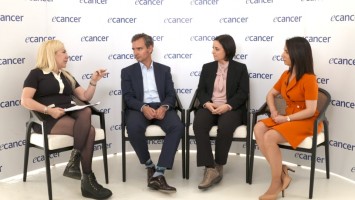
EC: Welcome to this expert discussion on prostate cancer. We are currently at ESMO 2025 in Berlin and I have the pleasure to be here together with these very esteemed colleagues.
GA: Gert Attard, medical oncologist in University College London, UK.
PR: My name is Pasquale Rescigno, I’m a medical oncologist from Newcastle University.
AH: My name is Axel Heidenreich and I’m a uro-oncologist based in Cologne in Germany.
EC: My name is Elena Castro, I’m a medical oncologist based in Madrid, Spain, and I will be chairing this discussion. Axel, we’ve heard the final results of the EMBARK study, this is practice changing.
AH: Oh yes, definitely. It’s practice changing because now for the first time we have been presented the overall results, so the overall survival results. We knew from the previous presentations that enzalutamide plus LHRH treatment or enzalutamide monotherapy has a significant improvement in terms of metastasis free survival but now we wanted to know if this transfers into a benefit in overall survival. What was presented today is that we have a relative risk reduction of about 40% in terms of a beneficial effect of LHRH analogues plus enzalutamide whereas enzalutamide alone only had a benefit of about 17%. So, for me, practice changing, yes, but only in the combination. What we might have to discuss is that if you look at the absolute values there is only a difference of about 8% in absolute survival benefit. So it would be nice to have some more molecular data to separate those patients who will benefit from LHRH treatment alone, maybe they only have SPOP mutations, and those who will benefit from the combination therapy. But, unfortunately, as it was said in the symposium today, there is no biomaterial available. But, for me, definitely it’s practice changing and we should use a combination of LHRH analogues and enzalutamide for these specific patients – biochemical relapse following a radical prostatectomy or radiation treatment with a PSA doubling time less than nine months.
LC: In this study the assessment was done with conventional imaging and now we are using PSMA PET more and more. Do you think this affects the validity of this study or this could have any impact on the implications?
AH: Not really because if you would do a PSMA PET scan in those patients who have this very short PSA doubling time, you will see what you expect: many patients who have occult metastatic disease based on conventional imaging. If we go back to all these studies in non-metastatic castration resistant disease and we look at the SPARTAN trial, there were a couple of 300 patients in whom PSMA PET scan was performed and there was no negative impact on the visibility of PSMA avid metastases and the response to treatment. And this will also not happen in the biochemical relapsed situation. So even nowadays we wouldn’t use a PSMA PET scan in those situations because we would not change treatment.
EC: Fantastic. And there is another study that combined enzalutamide with radiotherapy, the ENZARAD study, Gert, can you tell us anything about it?
GA: Yes, I think ENZARAD is really important because we’ve had STAMPEDE data for about five years now where in the STAMPEDE very high risk patients adding abiraterone to ADT improved survival to ADT and radiotherapy. But ENZARAD there is no benefit for survival or for MFS, which was the primary endpoint. So what this tells us is the boundary for where patients get benefit is somewhere in between the STAMPEDE very high risk and the inclusion for ENZARAD, so that was NCCN high risk. It’s going to sit somewhere in between. So we need to ensure we do not treat patients who are not STAMPEDE very high risk and true biomarker analysis, which I’m sure will follow from ENZARAD together with STAMPEDE and there’s a couple of other trials that are testing the question – ATLAS and [??] – identify that boundary, where’s that going to sit? It’s probably going to be a bit to the left of the STAMPEDE very high risk but not too far to the left. I think that’s really important. I also take away the message that although the overall study is negative, the hazard ratio in the lymph node positive group, which is a small group, 10% of patients, but the hazard ratio estimate is identical to STAMPEDE N1 positive. So I think we can extrapolate the data with STAMPEDE to enzalutamide, it’s not exclusive to abiraterone, that would make sense. In jurisdictions where abiraterone cannot be obtained or there are reasons why it cannot be used I think we should treat STAMPEDE very high risk either with abiraterone or enzalutamide. Yes, certainly more work needs to be done to identify the sweet spot. I’m agreeing with Axel that our practice changed based on the EMBARK data, based on MFS, so I think it’s astounding, the benefit in OS. But probably we are over-treating some biochemically relapsed patients because even in the control group more than half are alive after I think it’s ten years, 11 years. So can we better fine-tune the population of biochemical relapse that we should treat? But for now we should treat everyone who meets EMBARK criteria with ADT, as Axel said.
EC: So we’ve been discussing about having a biomarker for so long to help us optimise treatment and who are the patients who will benefit from one scheme or another and we are finally using those or finding a use for those in mHSPC and there were several presentations at this conference around that.
GA: Yes, I think the time of molecular precision medicine has arrived. It’s going to be slow and painful in many ways. So what we saw, new data here at ESMO ’25 is the CAPItello trial where patients receiving ADT abiraterone were randomised to capivasertib. They were selected based on PTEN loss using an IHC assay, so immunohistochemistry, and loss of 90% or more. So that was the intention to treat population and the hazard ratio was 0.81 for rPFS, immature for OS but 0.9 for OS. So there’s clearly a signal here but is it big enough? You discussed that in your beautiful discussion – is the magnitude of benefit great enough when we have so many other treatment options? Because this is a population who are going to get ADT ARPI, if they’re low volume they’re going to receive radiotherapy, there’s docetaxel, who should we use capivasertib for? I think there will be a subgroup and it needs to be determined. The other big presentation here at ESMO was PSMAddition and we haven’t fully seen the data yet because that’s yet to come but the hazard ratio for rPFS is 0.72, the event rate is around 30% in the control group. So clearly really exciting that we can delay rPFS so much, by such magnitude. It’s a crossover trial and that’s beautiful to see – the control patients all were offered at progression lutetium and there’s starting to be a signal for OS. So for PSMAddition we need a bit more time to see more events come through. Ideally we would also reach a point where we select the patients who need lutetium. Because 30% of this group are going to be in remission at ten years, ideally we know who those are in advance and we only offer lutetium to those who need it.
EC: And chemotherapy will still be a treatment option for patients with metastatic hormone sensitive disease. But perhaps we need to find schemes with less toxicity and there was the ARASAFE trial was presented also at ESMO. Axel, can you tell us anything about it?
AH: So the ARASAFE trial was a prospective randomised trial including 250 patients with mHSPC. It was a 1:1 randomisation, half of the patients received docetaxel at the typical dose of 75mg/m2 every three weeks and the other half of the patients were treated with docetaxel 50mg/m2 given every two weeks. Then the primary endpoint of this study was the reduction of grade 3-5 treatment-associated toxicity events. What we saw is the primary endpoint was reached, so grade 3-4 side effects in the 75mg arm was 71%, in the lower dosage it was around 60%. There was definitely a benefit in terms of reducing toxicity. We don’t have data on therapeutic outcomes so far, we only have data on PSA decline 26 weeks after initiation of treatment. We see 51% of patients in the low-dose arm achieved a PSA nadir of less than 0.2, as it was 49% in the 75mg/m2 arm. So we still have to wait if this difference in terms of therapeutic response for a surrogate marker of survival then really transfers into maybe a negative impact. But the bottom-line message is toxicity is reduced, thereby most probably quality of life will be maintained. Again, as we discussed, the most important question is who should receive docetaxel, who should not receive docetaxel. So we can use mutations like PTEN, like SPOP, we can use the PAM50 assay, so again going back into molecular medicine to identify patients who need intensive treatment, to separate those who need a de-intensification of treatment.
EC: Absolutely, very interesting times. We hope that slowly we get to understand better who are those patients. Pasquale, there are some new therapies being developed for metastatic castration resistant disease. You discussed yesterday some of these studies.
PR: Yes, there are at least two abstracts that were presented that are treating patients or considering patients with metastatic CRPC. One was an AstraZeneca trial called PETRANHA where patients were receiving a new PARP inhibitor that is a PARP1 selective treatment called saruparib in combination with an ARPI that was based on physician choice. There was a cohort of metastatic CRPC patients and a cohort of metastatic hormone sensitive patients. The metastatic CRPC were either prior ARPI naïve or they had another ARPI previously. In terms of safety, we consider probably we were expecting a little bit less toxicity from the saruparib while the readout that was presented at ESMO this year sounds more like they are comparable with other PARP inhibitors. So there are still quite a few cases of anaemia and nausea that we know are toxicities that are characteristic of PARP inhibitors. In terms of the efficacy there was 25%, of course it’s a small trial because it’s phase I/II. There were some patients in the metastatic CRPC that received a prior ARPI that had a response to the combination of saruparib and a second ARPI. However, looking carefully at the data for these two patients had a radiological response, one was a BRCA2 mutant patient and the other one was a CDK12 mutant patient. So we don’t know if it’s the saruparib on its own or it’s the combination that induced this response. In terms of the PSA response for the cohort that was metastatic hormone sensitive we saw an 83% PSA response defined as reaching a PSA less than 0.2. So this is slightly higher than ARPI alone in the metastatic hormone sensitive but, again, this is a phase I/II so we probably need to wait for the results of the phase III that is ongoing, it’s called EvoPAR, to understand more about toxicity and efficacy of saruparib with the ARPI. So interesting data but we probably need to wait another year or two to see the results of the phase III. And the other nice abstract was on a T-cell engager, an anti-Kallikrein 2, that was presented at this ESMO. The results were already presented and published in JCO earlier this year. What they presented at this ESMO was the translational data. It was quite nice data because what the author showed us during the meeting, Karen Autio, was that when we treat patients with T-cell engagers, so it’s a message that could be relevant not just for this trial but could be relevant for other similar drugs, we should probably look at the class of T-cell called Tpex that are pre-exhausted cells. So what they noticed is that if they were giving the treatment as a weekly subcutaneous or 3-weekly or 6-weekly there was a difference in terms of pre-exhausted T-cells with a higher Tpex in the 6-weekly arm. The difference between the pre-exhausted cells is that these cells can shift either towards completely exhausted cells or towards the effector. While in the arm with the subcutaneous weekly administration, or the 3-weekly, there were more terminally exhausted. So there is a difference just based on how often we give the treatment to our patients. So for immunotherapy like T-cell engagers, giving the treatment too often might cause resistance just because we are increasing the number of terminally exhausted T-cells, so less response to treatment. So this is a really new message. So maybe not relevant in terms of this specific drug but could be used across other trials as well.
EC: That is also very important because there is an entire programme of multiple trials being developed with [??] so it will be important to understand these mechanisms.
PR: I agree completely. Now we know that there are other trials ongoing in combination of [??] with docetaxel that are ongoing with radiotherapy as well, SBRT. So that could be extremely relevant as well in these other trials.
EC: So what we have seen is that there are several novelties for the management of prostate cancer patients and what we hear is that in the years to come there will still be more and more new molecules and new management for our prostate cancer patients. Thank you for listening to this expert discussion from ecancer.