
Supporting oncology professionals through education
The content on this site is intended for healthcare professionals only
The content on this site is intended for healthcare professionals only
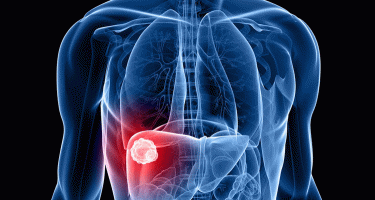
People with compromised liver function may be able to reduce their risk of liver cancer or slow its progression with a simple dietary change: eating less protein.
A Rutgers-led study in Science Advances found low-protein diets slowed liver tumour growth and cancer death in mice, uncovering a mechanism by which a liver's impaired waste-handling machinery can inadvertently fuel cancer.
Liver cancer remains one of the deadliest primary cancers in the United States, with a five-year survival rate of about 22%.
The American Cancer Society estimates there were 42,240 new cases in 2025 and 30,090 deaths.
The number of U.S. residents with compromised liver function who face elevated cancer risk is far larger.
About 1 in 4 U.S. adults has fatty liver disease, a condition that, along with viral hepatitis and heavy alcohol use, can raise the risk of cirrhosis as well as cancer.
"If you have liver disease or damage that prevents your liver from functioning correctly, you should seriously consider reducing your protein intake to lower the risk of developing liver cancer," said the study’s senior author, Wei-Xing Zong, a distinguished professor at the Rutgers Ernest Mario School of Pharmacy and a member of the Cancer Metabolism and Immunology Programme at Rutgers Cancer Institute, the state’s only NCI-designated Comprehensive Cancer Centre.
When people consume protein, the nitrogen can be converted into ammonia, a substance that’s toxic to the body and brain.
A healthy liver typically processes this ammonia into harmless urea, which is excreted via urine.
"The clinical observation that the liver’s ammonia-handling machinery is usually impaired in liver cancer patients is decades old," Zong said.
"The question that has remained unanswered until now is whether this impairment and the resulting ammonia buildup are a consequence of the cancer or a driver of the tumour growth.”
To test whether impaired ammonia processing drives cancer or is simply a byproduct, Zong's team utilised a technique to induce liver tumours in mice without crippling the ammonia-disposal system.
The researchers then used gene-editing tools to disable ammonia-processing enzymes in some, but not all, of those animals and compared outcomes.
The results were striking: Mice with disabled enzymes and higher ammonia levels developed heavier tumour burdens and experienced a much faster rate of mortality than those with functioning systems.
The researchers then traced the excess ammonia and discovered that it migrated into molecules that cancer cells require to thrive.
"The ammonia goes into amino acids and nucleotides, both of which tumour cells depend on for growth," said Zong.
With the mechanism established, the researchers tested a straightforward intervention: reducing dietary protein.
Mice fed low-protein food exhibited dramatically slower tumour growth and lived significantly longer than those that received food with standard levels of protein.
Individuals with healthy livers need not worry, as their systems can handle robust protein intake.
However, these findings have implications for the many people living with liver cancer, fatty liver disease, viral hepatitis or other liver impairments.
Any dietary changes, however, should be discussed with a physician, Zong said.
Standard cancer care guidelines typically recommend higher protein intake to help patients maintain muscle mass and strength during treatment.
The appropriate balance would likely depend on a patient's specific diagnosis and liver function, Zong added, but protein reduction may be right for people with elevated ammonia.
"Reducing the protein consumption may be the easiest way to get ammonia levels down," Zong said.
Source: Rutgers University
We are an independent charity and are not backed by a large company or society. We raise every penny ourselves to improve the standards of cancer care through education. You can help us continue our work to address inequalities in cancer care by making a donation.
Any donation, however small, contributes directly towards the costs of creating and sharing free oncology education.
Together we can get better outcomes for patients by tackling global inequalities in access to the results of cancer research.
Thank you for your support.